
The History of the Exit Device: A Life-Saving Innovation Born from Tragedy
The History of the Exit Device: A Life-Saving Innovation Born from Tragedy
Most people walk past a panic device without giving it a second thought.
It’s a simple piece of hardware. Push the bar, open the door, and continue on your way.
Yet behind that simple action lies a story of tragedy, innovation, and a determination to prevent history from repeating itself.
A Tragedy in England
The story begins on June 16, 1883, in Sunderland, England.
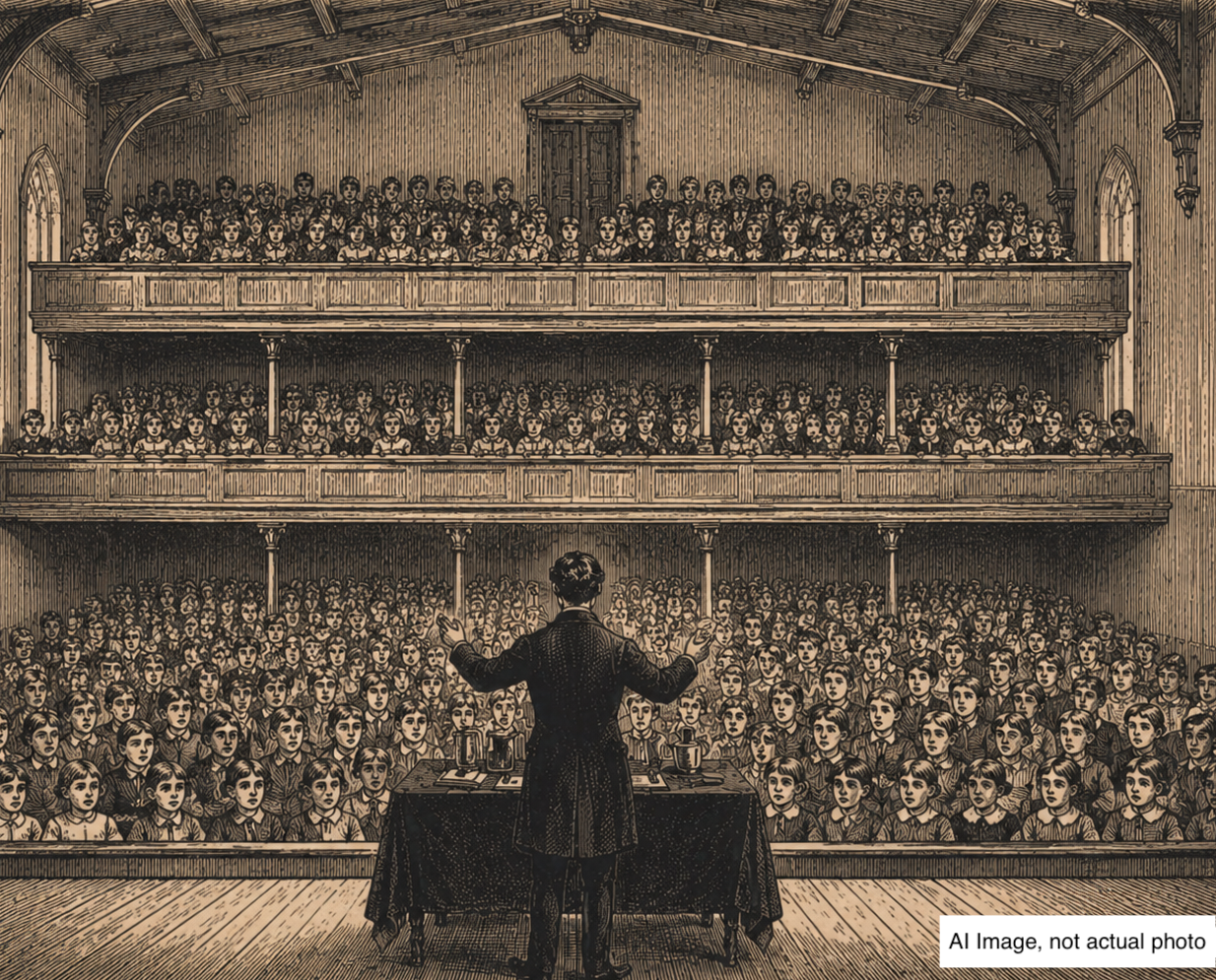
Approximately 2000 children attended a variety show held at Victoria Hall in Sunderland. The children were promised a prize after the performance to be distributed as they left. Following the show, hundreds of children rushed down the staircase toward the exit to claim their prize.
There was no fire. There was no structural collapse.
There was simply a crowd of excited children moving toward a door that could not accommodate them.
The result was devastating.
A total of 183 children lost their lives in what became known as the Victoria Hall Disaster.
The tragedy shocked England and sparked a search for a safer way to allow large crowds to exit buildings.
Robert Alexander Briggs and the Panic Bolt
In the years that followed, inventor Robert Alexander Briggs developed a solution.
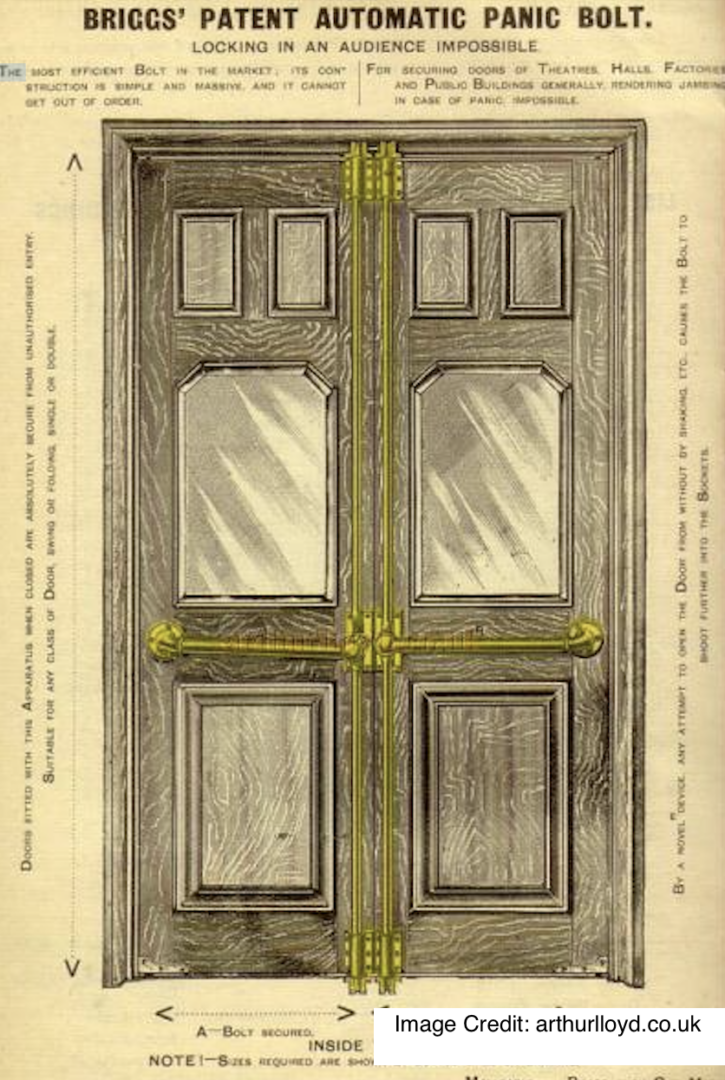
In 1891, Briggs applied for a patent for an invention titled “Improvements in Bolts and Fastenings for Doors of Theatres and Other Public Buildings.” The patent was granted in 1892.
His invention became known as the Briggs Panic Bolt.
The concept was revolutionary for its time. Instead of requiring an occupant to locate and operate a traditional lock or latch, the door could be opened by simply pushing against a horizontal bar.
Briggs understood an important truth that remains relevant today:
In an emergency or even in a moment of excitement, people do not stop to think about how a door operates. They simply push.
The panic bolt was designed to respond to that instinct.
One of the earliest installations was at London’s New Empire Theatre. Years later, when a fire occurred at the theatre in 1911, thousands of patrons were able to evacuate safely. The panic bolts performed exactly as intended.
The Iroquois Theatre Fire
While Briggs’ invention was gaining acceptance in England, another tragedy would forever change life safety in the United States.
Twenty years later, on December 30, 1903, fire broke out during a matinee performance at Chicago’s Iroquois Theatre.
More than 2,000 people were inside the building.
As smoke and flames spread, patrons rushed toward the exits. Many encountered inward-swinging doors, confusing latching arrangements, blocked exits, and severe crowd congestion.
Approximately 602 people lost their lives.
The Iroquois Theatre Fire remains one of the deadliest building fires in American history.
The disaster prompted sweeping changes to building codes, exit requirements, and life-safety practices throughout the United States.
Prinzler, DuPont and the Birth of the Modern Exit Device
Indianapolis hardware salesman Carl Prinzler began developing improvements to emergency exit hardware in the years following the Iroquois fire.
Working alongside architect Henry H. DuPont and supported by members of the Vonnegut family, Prinzler sought to create a more practical and commercially viable emergency exit device for American buildings.
Their work built upon the foundation established by Briggs years earlier.
Prinzler’s patents focused on creating a device that could be easily manufactured, reliably operated, and widely adopted in schools, theaters, assembly occupancies, and public buildings.
By 1910, patents had been granted for these improved designs.
In 1911, the company that would become synonymous with panic hardware was founded.
Its name combined the contributions of the people who helped bring the device to market, the Vonnegut family, architect Henry H. DuPont and Carl Prinzler.
A Simple Idea That Saves Lives
More than a century later, panic hardware remains one of the most important life-safety innovations in the history of the building industry.
While today’s devices incorporate modern materials, fire ratings, electrification, access control integration, and sophisticated engineering, the fundamental principle remains unchanged:
When people need to leave a building, the door must open easily.
The next time you push on an exit device, remember that behind that simple action is a story that began with 183 children in England, continued through one of America’s deadliest theater fires, and ultimately led to a life-saving innovation that protects building occupants every day.
Sometimes the most important inventions are also the simplest.
Sometimes all it takes is a push.